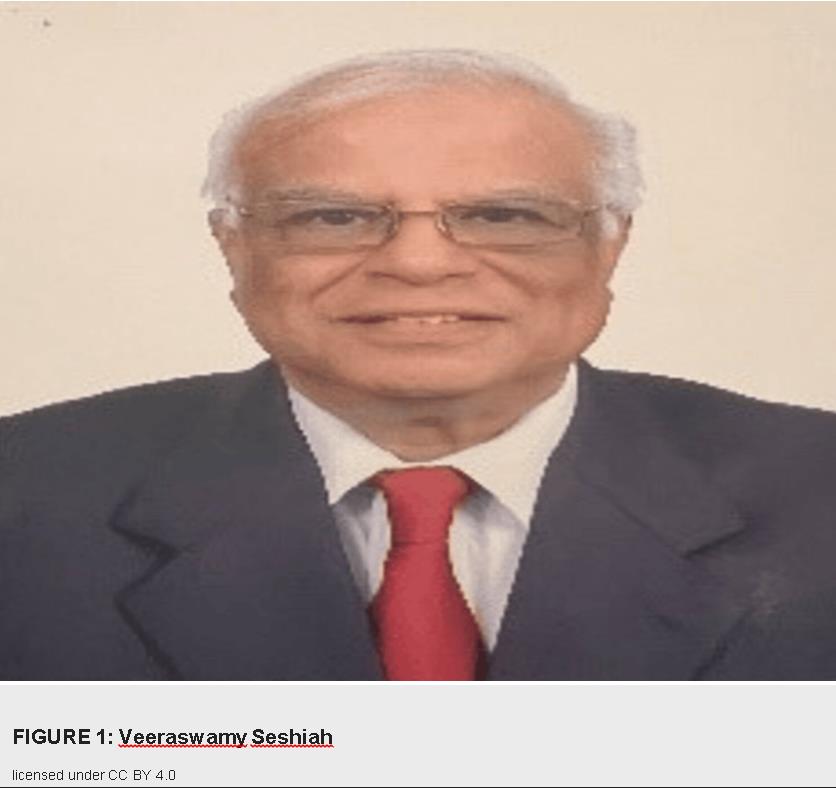
Review open access Article. Veeraswamy Seshiah: Father of Gestational Diabetes in India N Bhavatharini 1, Aruyer Chelvan 2, ARA Changanidi 3, Rajesh Jain 4 1. Diabetology, SRC Diabetes Care Center, Erode, IND 2. Department of Diabetes, SRC Diabetes Centre, Erode, IND 3. Department of Nephrology, Gleneagles Health City, Chennai, IND 4. Public Health, Jain Hospital and Research Center., Kanpur, IND Corresponding author: Rajesh Jain, [email protected] Submitted: October 10, 2024; Accepted: October 27, 2024; Published: October 29, 2024 Abstract Professor Dr. V. Seshiah, MD, FRCP, DSc, (Hony), is a distinguishprofessNadu’sTamilmNadu’su’s Dr. MGR Medical University and established the First Department of Diabetology in India at Madras Medical College in 1978. He was the patron of the Research Society for the Study of Diabetes in India and the founder patron of the Diabetes in Pregnancy Study Group, India (DIPSI). Additionally, he served as the Vice-Chair of the Executive Board of the International Association of Diabetes and Pregnancy Study Group. Dr. V Balaji and Dr. V Seshiah Diabetes Care Center & Research Institute, which he founded, received the Ar”y “ecoratio”s “AM”R “EV” S”AR” a”d “SA”NY” SEVA ME”AL” in 1965 with clasp HIMALAYAS. Dr. Seshiah was also the recipient of the DR. B.C.ROY National Award was given in 1988 for developing diabetology as the Indian College of Physicians provided a specialty in the country and the Master Teacher Award. Moreover, he was honored with the Lifetime Achievement Award by the International Diabetes Federation in 2017, being the first Indian to receive this award. In 2022, the President of India, Mr. Kovind, presented the Padma Shri to Dr. Veeraswamy Seshiah for Medicine. Categories: Endocrinology/Diabetes/Metabolism, Public Health, Health Policy Keywords: dips, Diabetes in a pregnancy study group of India (dips) criteria, gestational diabetes mellitus (dm), diabetes ” g” station,” “history” ic”l vignette”e.” Introduction and Background Prof V Seshiah is an honorary distinguished professor of life at Tamilnadu’s Dr. MGR Medical University, Chennai. He entered his 86th year on 10 March 104 (now 86 years). Prof Seshiah is a visionary, an astute clinician, and a teacher of par excellence, and he is revered as the Father of Diabetes in India (Figure 1) [1]. One must know the length and depth of his work as an author and authority in diabetes, especially gestational diabetes. His work on diabetes has continuously enlightened clinicians day by day, year by year, and decade by decade. Path-breaking evidence has become a source of guidance and reference in practice and policy decisions. His topics span all diabetes, especially hyperglycemia in pregnancy, epidemiology, and therapeutics. Prof Veeraswamy Seshiah was born in Perambur, North Chennai, Tamilnadu, on March 1038 to Mr. V V. Veeraswamy and Mrs. Bavanamma (a person with an aura of goappearSeshiah’sofsSeshiah’sh’s father worked in the Railways, and his mother was a homemaker. Other family members were his elder brother, Prof Dr. V Perumal, and a younger sister, Ms. Gajalaxshmi. His brother served as director of drug control in Tamil Nadu, and his sister was a housewife. The family lived at (Madras) Chennai throughout. Prof Seshiah, in his childhood, had been a frank and obedient child. Remembering an unforgettable incident, he said he met with an accident when he was five years old. They were asked to vacate and move out of Madras during the Second World Wartime to a village near Tindivanam. Once, he fell when he had a joy ride on a bullock cart with his playmates. His hecamcart’sr’sr artist’s wheel was a massive tearing of skin and scalp. It took months to recover from that injury, and that big scar is still present on the right lateral side of his scalp. Humorously, he said that he became very brilliant after that accident! PrSeshiah’sh’s family played a significant role in shaping his career. His father initially wanted him to pursue engineering, but his elder brother encouraged him to try Medicine and Engineering after he failed to get through. When he succeeded in the medical entrance, his brother supported his decision to pursue Medicine. Medicine support and determination led him to join the Madras Medical College in 1957, marking the beginning of his illustrious career. In 1962, during the Chinese war, there was a shortage of volunteers joining the army; Prof. Seshiah volunteered to join the Indian Army as a Lieutenant in the Army Medical Corps. In 1963, he became captain and was posted as a medical officer for the 1/3 Gurka battalion and then for the 7th Bihar infantry battalion in Jammu and Kashmir. In 1965, he participated (Figure 2) [1]. He participated in the war at “Uri Poonch” Bulge, J&K. In recognition of his service in the war theatre, he was awarded two prestigious awards: the “Samar Seva Star 1965″ and the ” Sainya Seva Medal” with a clasp Himalayas [2]. After completing his Army service, Prof Seshiah joined the Tamil Nadu Medical Service. While serving as an Assistant Professor of Medicine at Madras Medical College, he predicted that diabetes would become a widespread epidemic. In 1978, he established the first “Specialty Department of Diabetes” at Madras Medical College [3], the first of its kind in the country. At 40, Prof Seshiah became one of the youngest Professors. Recognizing the need to train physicians in this specialty, he initiated the “Postgraduate Course in Diabetology,” which was later recognized by the Medical Council of India. In 1980, he established the first “Feto-Placental-Maternal Unit” at the Institute of Obstetrics & Gynaecology, Government Maternity Hospital in Chennai. In 1988, in acknowledgment of his influential work in developing the field of Diabetology, he was honored with the prestigious “Dr. B.C. Roy National Award.” This award is the highest recognition for medical professionals by the Medical Council of India and is presented to the President of India. Prof Seshiah received this esteemed award from President Shri. R. Venkataraman [3]. Review Prof. Seshiah was honored with several awards for his academic, clinical, and research contributions, including the following: “Distinguished Member Award” from the Association of Physicians of India; “Master Teacher Award” from The